Ok, so maybe it is Tuesday night and not Wednesday, but I feel that what I'm about to do is somewhat sleazy. The four posts below have all been borrowed from two really great blogs that I found a few days ago and for the life of me cannot stop reading. Two posts are from Stuff ExPat Aid Workers Like, which is an extremely comical take on the clichés of development workers, and is frighteningly accurate. For every example that is given I'm sure I could come up with an equally telling one from Honduras.
The other posts are from a blog called Tales From the Hood, and is a series of essays about a inner struggle to balance being a full-on unapologetic professional aid worker while also staying eyes-open to the inconsistency, dilemma, paradox and sometimes plain absurdity that very clearly exist in the humanitarian aid industry.
Anyway, for the next few days I'll be in Atlanta, Georgia, living it up and celebrating the wedding of my good friend Mike Lawson. Congrats buddy, let's hope it your gift makes it through customs.
In other good news, our 115 pounds of sports equipment for local youth arrived today, and the quality is better than I could have hoped for. All is coming together well for our upcoming opening on the 5th of November. Enjoy the posts below, and please take the opportunity to read more from these blogs as they are well written and insightful.
Tuesday, October 18, 2011
Tales From the Hood-What Makes Good Aid *Good Aid*?
What Makes Good Aid *Good Aid*?
Good aid has five characteristics. Let’s talk about those:
1) Starts and ends with the needs of those affected by poverty, disaster, and conflict (a.k.a. “the poor”, “aid recipients”, “program participants”, “beneficiaries”…). Some might want to articulate this point as aid needs to be demand driven, rather than supply driven. How we think about aid – how we rationalize it, how emotionally and intellectually honest we are about why we do it, and why we do it the way we do it – matters. But if we’re to do it right, if we’re to plan and implement good aid, our starting point needs to be those whom we seek to serve. If that starting point is anything else (for example, the needs of a particular donor, surplus of something…) then a recipe for bad aid has already been started.
2) Follows good process. To put it very simply, you start with what the need is, define the most logical good solution, implement that solution, and evaluate your program or project against what you defined as the need. Some call this Project Cycle Management (PCM) (See also) Of course in actual practice there is a lot that goes into each of those steps. Knowing what the need is requires commitment and follow-through on assessments.
Defining the most logical good solution can require an amazing amount of organizational honesty and discipline – especially when an organization has defined it’s focus, capacity or “niche” very specifically. One of the most common mistakes which leads to bad aid is when an oranization, project or individual defines the solution in terms of what they have to offer, rather than in terms of what the most logical solution is. (I call this the “solutions in search of problems” approach.)
Evaluation, like assessment, is very often glossed over. Amateurs typically focus on implementation (and of course good implementation is critical), but implementation outside of the context of overall good process is meaningless.
3) Is evidence-based: Digging a little deeper into the assessment, planning, and evaluation steps of PCM, it is absolutely critical that assessments be done properly (see Texas In Africa’s outstanding series on how social scientists think – assessments are more than just asking a few villagers what they want). If you don’t understand clearly both the issue (problem) that you’re trying to address, you can’t design a workable response, and at the end you can’t know if you’ve been successful.
Yet in my experience, this is the single most common downfall of small startup NGOs/projects and amateurs: skimping on assessments and evaluations, or simply not doing them at all. This is partially because those things require specialized skills, resources and organizational bandwidth. Sometimes where an organization or project defines it’s “product” very specifically (volunteer teams, 1,000,000 T-shirts, shoes, etc.), there is little point in doing either assessments, planning, or evaluation because the implementors already know what they’re going to do.
Good aid will be disciplined enough to go through the process of collecting and analyzing evidence, and then basing action on need, not on the surplus of a particular resource.
4) Tool-box approach: Expanding the above point with respect to action/programming, good aid will approach available resources as “tools” inside a “tool-box.” Which is to say that good aid will select the right tool for the job. Bad aid, by contrast, typically uses backward logic by selecting the tool (action, program…) in advance of having evidence.
Where an organization or project has only a few tools in it’s box, it can take real organizational discipline to say “no” to programming. Again, this is a very common mistake of small startups and amateurs: the desperate desire to act (or the real, survival need for resources) drive many to try to operate outside of their actual capacity or expertise – sort of like using a screwdriver to pound nails.
5) Learns lessons-learned: While humanitarian aid and development are not as old as other fields (accounting or urban-planning), there is already a substantial body of experience and lessons-learned. Good aid does not repeat the mistakes of the past. While this sounds simple, in my experience this also can require an amazing level of organizational discipline (organizational discipline is a common theme…), particularly (again) where an organization is founded on the premise of a specific kind of activity, particularly where that activity contravenes known best-practices. The existence still of foreign-run “orphanages” across the Third World are but one outstanding example in real-life.
Learning the lessons-learned also requires that an individual, project or startup NGO be aware of the history, be looped into the overall aid conversation, be current with industry thinking.
This, also, requires organizational bandwidth and (wait for it…) discipline. It requires that people prioritize thinking and learning along with doing. It requires that organizations dedicate resources towards participating in learning events (sometimes feel like HRI-style “life-saving meetings”). It requires participation in coordination specifically, and generally being part of the larger community of practice overall. While few people would argue against learning the lessons learned in principle, in actual practice the realities of tight budgets, scarce resources, and staff already working 18-hour days frequently mean that the lessons learned do not get learned. And the result is frequently that while as an industry we know what to do and how to do it, many individual entities within the industry don’t.

Tales From the Hood-Local?
Tales From the Hood Local?
It is interesting to note that in all of the fervor to point out what’s wrong with aid, the most common critiques and frequently touted solutions alike come back to vaguely defined pronouncements about “local.” “Local” seems to be the holy grail of right thought and right action in the relief and development world. Support local industry, build local capacity, empower local producers, work with and through local partners, local NGOs/CBOs/FBOs, local knowledge, local language, local sensitivities, and on and on.
“Local” is past the point of being aid doctrine (remember, aid is a religion), and is now full-on aid dogma. It is the aid world debate trump card du jour. Any aid conversation one doesn’t happen to like the tone or direction of can be brought to a grinding halt with, “yes, but you didn’t mention local organizations…”
Yeah, I get it. And if you’ve spent more than a few minutes reading through previous posts on this blog you know that I embrace “local” as an article of faith in the Church of Aid. I myself have waved that sword vigorously in the past (and may do so again in the future). The values of local participation, leadership, knowledge, ownership in aid are so glaringly obvious as to be incontrovertible. After twenty years in this industry during which I have seen some wacky “aid” projects and met some truly misguided individuals practicing the sector, I still cannot think of a single person who disputes the value of local.
But at the risk of committing aid blasephemy I just have to say:
Local is not a magik bullet. While I absolutely believe that “local” is a critical, essential ingredient in “good aid”, it is not The Solution. Making everything local will not fix what’s wrong with aid. Making everything local is no guarantee of success or even a guarantee of the absence of meltdown in an aid project. Local people and organizations are just as capable of implementing bad aid, and every bit as susceptible to the temptations of dumbassery as internationals; local knowledge and wisdom are often plain wrong; local incompetence is still incompetence. We often feel ethnocentric saying so, but we don’t do ourselves or those we claim we want to help any favors by pretending it’s any other way.
How local is local? “Local” is one of those aid jargon terms that gets thrown around a lot, but that few define or use specifically. There’s local and there’s local and then again, there’s local. To someone living in Ha Tay, people from Ha Noi are not local. Except by comparison to people fromDa Nang. To Martians, everybody on Planet Earth is local. The range of what qualifies as a “local NGO” is so wide as to make the term practically useless (same applies to INGOs, by the way). A “local NGO” can be two little old ladies in Newara Eliya with one sewing machine between them… or a four-storey building in La Paz with wifi, white Landcruisers, and an international travel budget. Some might argue that FEMA is a local organization. The range of what these respective kinds of “local NGOs” and everything else in between can offer in terms of capacity, output, and program quality is similarly great. We don’t advance the cause of local by lumping and using the term imprecisely.
Provincialism is a constant tension. There is a dark side to local. It’s called provincialism – the idea that the way we do it here is the only way that works. It’s another way to grind conversations to a halt before they even get started, silence debate about what’s possible, are kill ideas dead before there’s been any actual discussion. It’s a problem to take seriously. Obviously we don’t want to try to implement “one size fits all” solutions. But we have to resist the “no size fits us” argument as well.
Internationalism is a reality. The common theme of aid critiques from Bill Easterly to Fiona Terry to Linda Polman to the righteous indignation of the aid blogosphere seems generally to be that “aid is messed up because it’s being run by a bunch of foreigners who have conflicted motivations and don’t sufficiently appreciate ‘local.’” And while it’s hard to dispute their cases – the evidence is pretty clear – what I have not seen yet is substantive discussion around the simple reality that internationalism is a reality and what that means moving forward.
It is far past time to move beyond the simple critique. International aid and international aid organizations exist. Like it or not, they’re not going away. Even if totally localizing everything would work and was practical (it wouldn’t, and isn’t), it still would not happen. For better or for worse we’re in a globalized society where those with means, due to a wide range of motivations, do and will go elsewhere to “help.” We don’t do ourselves or anyone else any service by pretending or wishing that it was otherwise. We need to develop paradigms and language that take this international reality into account. We need to find ways to stop pitting “local” against “international”, and focus on making aid a conversation rather than a series of declarations.
Featured Content: #14: Stuff EAW Life: Hot showers
#14 Hot showers-Expat Aid Workers like hot showers. They are accustomed to bathing once a day in hot water at home, and hope for no less when living in another country.
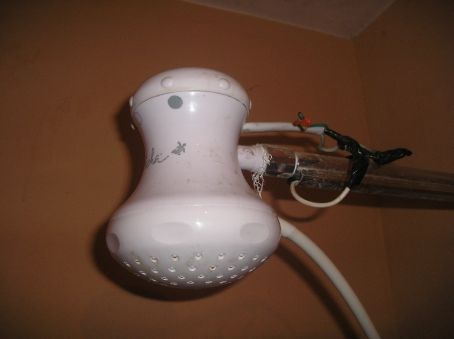
Hot water doesn’t come already installed in the house in many countries, however, and Expat Aid Workers may have to send their drivers to purchase them an electric shower, commonly referred to in Latin America as a “suicide shower“.
These come in various designs. They are sometimes manufactured locally, but may be also imported. (Check here for a variety of electric showers). They are installed in the bathroom by the handyman from the office and are of dubious safety. Expat Aid Workers grow up learning not to use electric hair dryers and shavers while in the bathtub due to the risk of electric shock and often question the wisdom of having exposed electrical wires near water.

The lure of the hot water shower can be too much, however, and the Expat Aid Worker gives in against his or her better judgment. A hot shower is one of the few small pleasures in an Expat Aid Worker’s otherwise difficult life.
When spending a few days in a village, staying at a local guest house in a small town or living like a Peace Corps worker in a real live community for an extended period of time, cold water showers or bucket baths are a hardship that Expat Aid Workers must endure. In these situations, it’s hard to get and stay clean. Even if there is someone attending to the Expat Aid Worker, he or she may not always have hot water to bathe with. There may not be water at all in some cases, though surely if there is water, the locals will allow the Expat Aid Worker to make first use of it.
In any case, taking a cold shower on a chilly morning is just not pleasant. And no matter how many cold bucket baths per day are suffered through, it’s just plain hard to stay clean in the absence of hot water.
 Of special difficulty is dirt accumulated on the feet and underneath the toenails, since often the Expat Aid Worker will be forced to walk on sand or dirt paths throughout the day, and he or she may be wearing Tevas or Birkenstocks. Additionally, female Expat Aid Workers using cold water to shave their legs are prone to razor burn, small irritating bumps, or persistent stubble. Upon returning from “the field,” the first things the Expat Aid Worker will seek out are a hot shower and alcohol, in no particular order, followed in most cases by Internet and chocolate.
Hot showers are a vital necessity for washing away the grime accumulated during dusty rides along unpaved roads and the sweat from spending a few hours in the sun looking at a WASH project or a health facility out in the field. They are just one of the many basic human necessities that Expat Aid Workers sometimes do without, or risk their lives to obtain, while conducting their important life-saving work for all of humanity.
Hot water doesn’t come already installed in the house in many countries, however, and Expat Aid Workers may have to send their drivers to purchase them an electric shower, commonly referred to in Latin America as a “suicide shower“.
These come in various designs. They are sometimes manufactured locally, but may be also imported. (Check here for a variety of electric showers). They are installed in the bathroom by the handyman from the office and are of dubious safety. Expat Aid Workers grow up learning not to use electric hair dryers and shavers while in the bathtub due to the risk of electric shock and often question the wisdom of having exposed electrical wires near water.

When spending a few days in a village, staying at a local guest house in a small town or living like a Peace Corps worker in a real live community for an extended period of time, cold water showers or bucket baths are a hardship that Expat Aid Workers must endure. In these situations, it’s hard to get and stay clean. Even if there is someone attending to the Expat Aid Worker, he or she may not always have hot water to bathe with. There may not be water at all in some cases, though surely if there is water, the locals will allow the Expat Aid Worker to make first use of it.
In any case, taking a cold shower on a chilly morning is just not pleasant. And no matter how many cold bucket baths per day are suffered through, it’s just plain hard to stay clean in the absence of hot water.
Of special difficulty is dirt accumulated on the feet and underneath the toenails, since often the Expat Aid Worker will be forced to walk on sand or dirt paths throughout the day, and he or she may be wearing Tevas or Birkenstocks. Additionally, female Expat Aid Workers using cold water to shave their legs are prone to razor burn, small irritating bumps, or persistent stubble. Upon returning from “the field,” the first things the Expat Aid Worker will seek out are a hot shower and alcohol, in no particular order, followed in most cases by Internet and chocolate.Hot showers are a vital necessity for washing away the grime accumulated during dusty rides along unpaved roads and the sweat from spending a few hours in the sun looking at a WASH project or a health facility out in the field. They are just one of the many basic human necessities that Expat Aid Workers sometimes do without, or risk their lives to obtain, while conducting their important life-saving work for all of humanity.
Subscribe to:
Posts (Atom)