Sunday, October 30, 2011

Featured Content: Honduras Becomes Cocaine Hub

TEGUCIGALPA, Honduras (AP) — On Honduras' swampy Mosquitia coast, entire villages have made a way of life off the country's massive cocaine transshipment trade. In broad daylight, men, women and children descend on passing go-fast boats to offload bales of cocaine destined for the United States.

Along the Atlantic coast, the wealthy elite have accumulated dozens of ranches, yachts and mansions from the drug trade. And in San Pedro Sula, local gangs moving drugs north have spawned armies of street-level dealers whose violence has given the rougher neighborhoods of the northern industrial city a homicide rate that is only comparable to Kabul, Afghanistan.

Long an impoverished backwater in Central America, Honduras has become a main transit route for South American cocaine.

"Honduras is the number one offload point for traffickers to take cocaine through Mexico to the U.S.," said a U.S. law enforcement official who could not be quoted by name for security reasons. A U.S. State Department report released in March called Honduras "one of the primary landing points for South American cocaine."

Almost half of the cocaine that reaches the United States is now offloaded somewhere along the country's coast and heavily forested interior — a total of 20 to 25 tons each month, according to U.S. and Honduran estimates. Authorities intercept perhaps 5 percent of that, according to calculations by The Associated Press based on official estimates of flow and seizures.

The flow is hard to stem, said Alfredo Landaverde, a former adviser to the Honduran security ministry, because there are few other sources of cash income here.

"We have to recognize that this society is very vulnerable," Landaverde said. "This is a country permeated by corruption, among police commanders, businessmen, politicians."

The country's isolated, impoverished Atlantic coast, remote ranches and largely unguarded border with Guatemala — where much of the cocaine is taken — also make it a haven for traffickers.

"When the traffickers are unloading a go-fast boat in (the Atlantic coast province of) Gracias a Dios, you can sometimes see 70 to 100 people of all ages out there helping unload it," said the U.S. law enforcement official. "The traffickers look for support among local populations."

In the past year, authorities seized 12 tons of cocaine, according to the Honduran government — a vast improvement from previous years, but still a small portion of the estimated 250 to 300 tons that come through annually. Most of the cocaine arrives in Honduras via the sea, in speedboats, fishing vessels and even submersibles. In July, the U.S. Coast Guard, with Honduras' help, detained one such craft that had been plying the waters with about 5 tons of cocaine per trip.

Fishermen who once worked catching lobster now look instead for a much more prized catch, the so-called "white lobster" — bales of cocaine jettisoned by drug traffickers to either escape detection or to be picked up by another boat.

Honduras is also by far the region's biggest center for airborne smuggling. Of the hundreds of illicit flights northward out of South America, 79 percent land in Honduras, said the U.S. official. Ninety-five percent of those flights hail from Venezuela, which also has become a link for cocaine produced elsewhere.

Landing aircraft in Honduras was once so profitable and planes so easy to get that traffickers would sometimes simply offload the drugs and burn the aircraft, rather than take off again from dangerously rudimentary clandestine landing strips. Last year, however, they started reusing the planes to ferry loads of bulk cash back to Colombia, the U.S. State Department report said. Authorities found one load of $9 million in U.S. cash stuffed in plastic bags in the trunk of a car, and millions at a time in suitcases at local airports.

Earlier this year, as aircraft became more difficult to obtain, traffickers stole a military plane from the San Pedro Sula army base on the Atlantic coast, said Landaverde, adding that soldiers were accomplices to the theft.

"The plane is left outside," he said. "Some guys turn it on and take off. Nobody leaves a plane like that, ready to fly." In fact, one of the soldiers involved in that incident was later arrested in September with other ex-soldiers as they allegedly waited to meet a drug flight on the country's Atlantic coast.

It is not just poverty-stricken fishermen and corrupt soldiers who are the beneficiaries of the emergent cocaine republic. Last week, authorities seized 13 luxurious homes and ranches and 17 boats in the first such mass raid since the country enacted a drug-properties seizure law in 2010. All were owned by local people.

Key members of the region's business community who have hotel, real estate and retail holdings have been named as associates of the cartels, often for money laundering. Nor are the drug trade's ripple effects restricted to the coast.

Copan, a Guatemalan border province popular with tourists because of its Mayan ruins, is a lawless area dominated by business interests tied to the drug trade, said a radio station owner who asked not to be quoted by name for security reasons.

"These people move without shame in politics and the business world," the station owner said. "They are involved in large-scale businesses in tourism. This region has been separated from the nation's territory. It is their lair."

At the other end of the economic spectrum are local street gangs, who are often paid in drugs as well as cash to move drugs north. Their ranks are growing and competition among them has pushed up the country's escalating homicide rate to one of the highest in the world. The country of 7.7 million people saw 6,200 killings in 2010. That's the equivalent of 82.1 homicides per 100,000 people — well above the 66 per 100,000 in neighboring El Salvador.

Others are becoming players in the bulk trade, the U.S. official said, remarking that, "Lately, we've seen some gangs that will purchase the cocaine and resell it."

The high volume of drugs coupled with the alarming homicide rate is tough to address in a nation where many police and army officers are working with drug gangs. Corrupt law enforcement officials had a fierce foe in the person of former Honduran Security Minister Oscar Alvarez, who was fired by President Porfirio Lobo in September after proposing a law to purge the police force of corrupt cops.

Alvarez had said publicly that some corrupt police essentially act as air traffic controllers for the drug flights. When a suspected drug flight was detected in August, Alvarez was quoted by a local newspaper as saying that two police officials not assigned to the district were in the area — their cellphone signals were traced to the control tower where the plane landed.

Alvarez claimed he was fired because of his campaign to clean up the police force, saying, "It was easier to get rid of a minister than to get rid of a corrupt cop."

But his replacement, Pompeyo Bonilla, said that given Honduras' highly protective labor laws, a mass firing of police officers probably would have been quickly followed by the reinstatement of many. He also claimed that Alvarez overstepped his authority by sending his proposed police cleanup law to congress without even telling Lobo.

"The president heard about it on television," Bonilla said.

Alvarez, who left for the United States soon after his dismissal, was not available for an interview, according to an unidentified woman who answered his U.S. cellphone number.

U.S. Ambassador Lisa Kubiske said she expects to work well with Bonilla. "President Lobo's administration is totally serious about fighting the cartels," Kubiske said. "When you talk to them, counternarcotics is almost the first word out of their mouths."

Alvarez was accustomed to dropping bombshells, including the claim that fugitive Mexican drug lord Joaquin "El Chapo" Guzman had visited Honduras' border region next to Guatemala.

In March, police under Alvarez's command raided a remote mountain lab in northeastern Honduras. Alvarez said the lab processed cocaine from the paste of partly processed coca leaves, the first time that would have been done outside South America and an ominous development for Honduras. The lab, however, had apparently not yet been put to use. Bonilla said the lab was a small one, quickly dismantled, and no other such lab has been discovered in Honduras. "We are rather more a transit route" than a producer or processor, Bonilla said.

Some doubt the lab was intended to process coca paste; it may have been simply dedicated to cutting and repackaging imported cocaine, which is usually cut many times before it reaches the street.

"We haven't seen any evidence of cocaine processing taking place in Honduras so far," the U.S. official said, adding, "Twelve thousand kilos of cocaine were seized in Honduras this year, and we haven't seen a single ounce of cocaine paste."

Associated Press writer Luis Alonso in Washington contributed to this report.

Wednesday, October 26, 2011

Up in the Air

I just got back from a whirlwind weekend in Atlanta, GA for a good friend's wedding, which was a welcome 3 day break from Honduras. Anyway, before the flight I got into a conversation with another volunteer in the airport at San Pedro Sula about flight rituals, which got me thinking that it would probably make a pretty decent blog post. I realized, when talking to her, that I do have a lot of "rituals," which really surprised me. I'm not a superstitious person, but I feel almost required to do a cacophonous list of things before and during the flight.

It also reminded me of the first time I flew into Honduras, and how absolutely terrifying tense of an experience it was. I remember that when we landed, barely missing the rooftops of mountain clung houses, that everyone in the plane broke out into applause. Not a bad way to start two years of your life.

 
Landing at Toncontin is still considered one of the most technically difficult and dangerous landings for commercial airliners. 

"Air "Rituals"

Window seat. Always. No questions asked. To me it's the smarter move for comfort and a more enjoyable flight. I think part of the reason for me doing this was because as a kid I would sit on the roof of our house and watch the planes line up for their approach into O'Hare. Roof sitting, always classic.

If I'm not drinking, by the way cheers to the Delta flight attendant who hooked me up with about 7 free drink tickets for my flight back to Honduras. Anyway, if I'm not drinking,  I'm ordering a milk with ice. I blame that one on a roommate from college. Also, nowadays it is great to get a cold glass of milk, because a lot of times milk in Honduras is served warm or heated up. I still don't get that one.

I'll always sneak my headphones on during takeoff to play the same song, and I have no idea why. If you start playing Jack's Mannequin, "The Mixed Tape" as the pilot throttles the engines up for take off, I've found that the music matches the actions of the plane taking off perfectly. Try it.

The kid in me loves turbulance. If I'm paying $400 for a ticket, you better make the flight as memorable and as fun as possible.

Don't drink for at least 12 hours before and international flight. Standing in lines con una goma is terrrible. Read a book instead.

Finally, there is not a better thing in the world than flying back into Chicago. Whether it be MDW or O'Hare, day or night. Seeing the city skyline back-dropped against Lake Michigan is an unbeatable experience. It's made even better by the fact that it usually means your coming home, back to green colored street signs and "fireworks over Lake Michigan."

Tuesday, October 18, 2011

"Sleazy Wednesday"

Ok, so maybe it is Tuesday night and not Wednesday, but I feel that what I'm about to do is somewhat sleazy. The four posts below have all been borrowed from two really great blogs that I found a few days ago and for the life of me cannot stop reading. Two posts are from Stuff ExPat Aid Workers Like, which is an extremely comical take on the clichés of development workers, and is frighteningly accurate.  For every example that is given I'm sure I could come up with an equally telling one from Honduras.

The other posts are from a blog called Tales From the Hood, and is a series of essays about a inner struggle to balance being a full-on unapologetic professional aid worker while also staying eyes-open to the inconsistency, dilemma, paradox and sometimes plain absurdity that very clearly exist in the humanitarian aid industry.

Anyway, for the next few days I'll be in Atlanta, Georgia, living it up and celebrating the wedding of my good friend Mike Lawson. Congrats buddy, let's hope it your gift makes it through customs.

In other good news, our 115 pounds of sports equipment for local youth arrived today, and the quality is better than I could have hoped for. All is coming together well for our upcoming opening on the 5th of November. Enjoy the posts below, and please take the opportunity to read more from these blogs as they are well written and insightful.

Tales From the Hood-What Makes Good Aid *Good Aid*?

What Makes Good Aid *Good Aid*?

Good aid has five characteristics. Let’s talk about those:

1) Starts and ends with the needs of those affected by poverty, disaster, and conflict (a.k.a. “the poor”, “aid recipients”, “program participants”, “beneficiaries”…). Some might want to articulate this point as aid needs to be demand driven, rather than supply driven. How we think about aid – how we rationalize it, how emotionally and intellectually honest we are about why we do it, and why we do it the way we do it – matters. But if we’re to do it right, if we’re to plan and implement good aid, our starting point needs to be those whom we seek to serve. If that starting point is anything else (for example, the needs of a particular donor, surplus of something…) then a recipe for bad aid has already been started.

2) Follows good process. To put it very simply, you start with what the need is, define the most logical good solution, implement that solution, and evaluate your program or project against what you defined as the need. Some call this Project Cycle Management (PCM) (See also) Of course in actual practice there is a lot that goes into each of those steps. Knowing what the need is requires commitment and follow-through on assessments.

Defining the most logical good solution can require an amazing amount of organizational honesty and discipline – especially when an organization has defined it’s focus, capacity or “niche” very specifically. One of the most common mistakes which leads to bad aid is when an oranization, project or individual defines the solution in terms of what they have to offer, rather than in terms of what the most logical solution is. (I call this the “solutions in search of problems” approach.)

Evaluation, like assessment, is very often glossed over. Amateurs typically focus on implementation (and of course good implementation is critical), but implementation outside of the context of overall good process is meaningless.

3) Is evidence-based: Digging a little deeper into the assessment, planning, and evaluation steps of PCM, it is absolutely critical that assessments be done properly (see Texas In Africa’s outstanding series on how social scientists think – assessments are more than just asking a few villagers what they want). If you don’t understand clearly both the issue (problem) that you’re trying to address, you can’t design a workable response, and at the end you can’t know if you’ve been successful.

Yet in my experience, this is the single most common downfall of small startup NGOs/projects and amateurs: skimping on assessments and evaluations, or simply not doing them at all. This is partially because those things require specialized skills, resources and organizational bandwidth. Sometimes where an organization or project defines it’s “product” very specifically (volunteer teams, 1,000,000 T-shirts, shoes, etc.), there is little point in doing either assessments, planning, or evaluation because the implementors already know what they’re going to do.

Good aid will be disciplined enough to go through the process of collecting and analyzing evidence, and then basing action on need, not on the surplus of a particular resource.

4) Tool-box approach: Expanding the above point with respect to action/programming, good aid will approach available resources as “tools” inside a “tool-box.” Which is to say that good aid will select the right tool for the job. Bad aid, by contrast, typically uses backward logic by selecting the tool (action, program…) in advance of having evidence.

Where an organization or project has only a few tools in it’s box, it can take real organizational discipline to say “no” to programming. Again, this is a very common mistake of small startups and amateurs: the desperate desire to act (or the real, survival need for resources) drive many to try to operate outside of their actual capacity or expertise – sort of like using a screwdriver to pound nails.

5) Learns lessons-learned: While humanitarian aid and development are not as old as other fields (accounting or urban-planning), there is already a substantial body of experience and lessons-learned. Good aid does not repeat the mistakes of the past. While this sounds simple, in my experience this also can require an amazing level of organizational discipline (organizational discipline is a common theme…), particularly (again) where an organization is founded on the premise of a specific kind of activity, particularly where that activity contravenes known best-practices. The existence still of foreign-run “orphanages” across the Third World are but one outstanding example in real-life.
Learning the lessons-learned also requires that an individual, project or startup NGO be aware of the history, be looped into the overall aid conversation, be current with industry thinking.

This, also, requires organizational bandwidth and (wait for it…) discipline. It requires that people prioritize thinking and learning along with doing. It requires that organizations dedicate resources towards participating in learning events (sometimes feel like HRI-style “life-saving meetings”). It requires participation in coordination specifically, and generally being part of the larger community of practice overall. While few people would argue against learning the lessons learned in principle, in actual practice the realities of tight budgets, scarce resources, and staff already working 18-hour days frequently mean that the lessons learned do not get learned. And the result is frequently that while as an industry we know what to do and how to do it, many individual entities within the industry don’t.

Tales From the Hood-Local?

Tales From the Hood Local?

It is interesting to note that in all of the fervor to point out what’s wrong with aid, the most common critiques and frequently touted solutions alike come back to vaguely defined pronouncements about “local.” “Local” seems to be the holy grail of right thought and right action in the relief and development world. Support local industry, build local capacity, empower local producers, work with and through local partners, local NGOs/CBOs/FBOs, local knowledge, local language, local sensitivities, and on and on.

“Local” is past the point of being aid doctrine (remember, aid is a religion), and is now full-on aid dogma. It is the aid world debate trump card du jour. Any aid conversation one doesn’t happen to like the tone or direction of can be brought to a grinding halt with, “yes, but you didn’t mention local organizations…”

Yeah, I get it. And if you’ve spent more than a few minutes reading through previous posts on this blog you know that I embrace “local” as an article of faith in the Church of Aid. I myself have waved that sword vigorously in the past (and may do so again in the future). The values of local participation, leadership, knowledge, ownership in aid are so glaringly obvious as to be incontrovertible. After twenty years in this industry during which I have seen some wacky “aid” projects and met some truly misguided individuals practicing the sector, I still cannot think of a single person who disputes the value of local.

But at the risk of committing aid blasephemy I just have to say:

Local is not a magik bullet. While I absolutely believe that “local” is a critical, essential ingredient in “good aid”, it is not The Solution. Making everything local will not fix what’s wrong with aid. Making everything local is no guarantee of success or even a guarantee of the absence of meltdown in an aid project. Local people and organizations are just as capable of implementing bad aid, and every bit as susceptible to the temptations of dumbassery as internationals; local knowledge and wisdom are often plain wrong; local incompetence is still incompetence. We often feel ethnocentric saying so, but we don’t do ourselves or those we claim we want to help any favors by pretending it’s any other way.

How local is local? “Local” is one of those aid jargon terms that gets thrown around a lot, but that few define or use specifically. There’s local and there’s local and then again, there’s local. To someone living in Ha Tay, people from Ha Noi are not local. Except by comparison to people fromDa Nang. To Martians, everybody on Planet Earth is local. The range of what qualifies as a “local NGO” is so wide as to make the term practically useless (same applies to INGOs, by the way). A “local NGO” can be two little old ladies in Newara Eliya with one sewing machine between them… or a four-storey building in La Paz with wifi, white Landcruisers, and an international travel budget. Some might argue that FEMA is a local organization. The range of what these respective kinds of “local NGOs” and everything else in between can offer in terms of capacity, output, and program quality is similarly great. We don’t advance the cause of local by lumping and using the term imprecisely.

Provincialism is a constant tension. There is a dark side to local. It’s called provincialism – the idea that the way we do it here is the only way that works. It’s another way to grind conversations to a halt before they even get started, silence debate about what’s possible, are kill ideas dead before there’s been any actual discussion. It’s a problem to take seriously. Obviously we don’t want to try to implement “one size fits all” solutions. But we have to resist the “no size fits us” argument as well.

Internationalism is a reality. The common theme of aid critiques from Bill Easterly to Fiona Terry to Linda Polman to the righteous indignation of the aid blogosphere seems generally to be that “aid is messed up because it’s being run by a bunch of foreigners who have conflicted motivations and don’t sufficiently appreciate ‘local.’” And while it’s hard to dispute their cases – the evidence is pretty clear – what I have not seen yet is substantive discussion around the simple reality that internationalism is a reality and what that means moving forward.

It is far past time to move beyond the simple critique. International aid and international aid organizations exist. Like it or not, they’re not going away. Even if totally localizing everything would work and was practical (it wouldn’t, and isn’t), it still would not happen. For better or for worse we’re in a globalized society where those with means, due to a wide range of motivations, do and will go elsewhere to “help.” We don’t do ourselves or anyone else any service by pretending or wishing that it was otherwise.  We need to develop paradigms and language that take this international reality into account. We need to find ways to stop pitting “local” against “international”, and focus on making aid a conversation rather than a series of declarations.

Featured Content: #14: Stuff EAW Life: Hot showers

#14 Hot showers-Expat Aid Workers like hot showers. They are accustomed to bathing once a day in hot water at home, and hope for no less when living in another country.

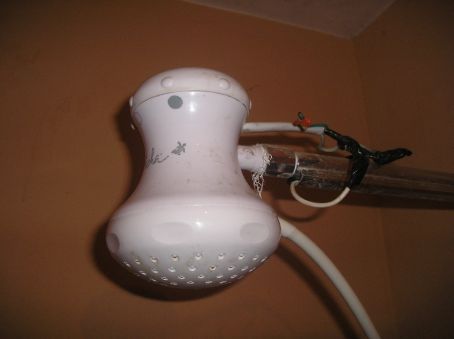
Hot water doesn’t come already installed in the house in many countries, however, and Expat Aid Workers may have to send their drivers to purchase them an electric shower, commonly referred to in Latin America as a “suicide shower“.

These come in various designs. They are sometimes manufactured locally, but may be also imported. (Check here for a variety of electric showers). They are installed in the bathroom by the handyman from the office and are of dubious safety. Expat Aid Workers grow up learning not to use electric hair dryers and shavers while in the bathtub due to the risk of electric shock and often question the wisdom of having exposed electrical wires near water.

The lure of the hot water shower can be too much, however, and the Expat Aid Worker gives in against his or her better judgment. A hot shower is one of the few small pleasures in an Expat Aid Worker’s otherwise difficult life.

When spending a few days in a village, staying at a local guest house in a small town or living like a Peace Corps worker in a real live community for an extended period of time, cold water showers or bucket baths are a hardship that Expat Aid Workers must endure. In these situations, it’s hard to get and stay clean. Even if there is someone attending to the Expat Aid Worker, he or she may not always have hot water to bathe with. There may not be water at all in some cases, though surely if there is water, the locals will allow the Expat Aid Worker to make first use of it.


In any case, taking a cold shower on a chilly morning is just not pleasant. And no matter how many cold bucket baths per day are suffered through, it’s just plain hard to stay clean in the absence of hot water.

Of special difficulty is dirt accumulated on the feet and underneath the toenails, since often the Expat Aid Worker will be forced to walk on sand or dirt paths throughout the day, and he or she may be wearing Tevas or Birkenstocks. Additionally, female Expat Aid Workers using cold water to shave their legs are prone to razor burn, small irritating bumps, or persistent stubble. Upon returning from “the field,” the first things the Expat Aid Worker will seek out are a hot shower and alcohol, in no particular order, followed in most cases by Internet and chocolate.

Hot showers are a vital necessity for washing away the grime accumulated during dusty rides along unpaved roads and the sweat from spending a few hours in the sun looking at a WASH project or a health facility out in the field. They are just one of the many basic human necessities that Expat Aid Workers sometimes do without, or risk their lives to obtain, while conducting their important life-saving work for all of humanity.

Featured Content: #19: Stuff EAW Like-Passports

 
Although they seldom admit this in public, Expat Aid Workers love their passports. And of course, they love collecting stamps in their passports. The more unusual, the better. And best of all, from countries they’re not really supposed to visit. (for Americans that might be Cuba or Yemen, for Egyptians that would be Israel, for everyone you may think of Iran, etc.)

Expat Aid Worker passports are accessories to the act of establishing field cred, and so it is very common for Expat Aid Workers to want to share the stories of how they acquired particular unusual and/or forbidden stamps: ”I was stuck at the Syria-Lebanon border crossing for six hours overnight and I had to negotiate in Arabic with the Lebanese customs officer to give me a visa even though foreigners can only get their visa on arrival at the airport,” for example, is the kind of hard-to-top story that immediately sets the teller apart from newbies and poseurs.

For effect it is, of course, important that the Expat Aid Worker’s passport be reasonably mishandled and the cover be somewhat wiped. A variety of security stickers on the back is a useful touch as well. A new passport might incur a haughty look from veteran Expat Aid Worker, until an apologetic “I had to get it renewed, I was running out of pages” is uttered.

But it’s not just about owning a busy passport: as with a trophy wife or expensive pet, the fun is not complete until the EAW can show off that official scrapbook.

Our Expat Aid Worker will carry her or his passport in pocket while at home, generally with the excuse that he or she has to stop by the consulate of Bouringa to see if a new visa/residency permit is ready. There’s a good chance friends will be curious enough to ask to see it, or will see that they’re burning to display it and so will indulge by asking to take a look. Either way, the Expat Aid Worker is set!

For tougher audiences – like, actual disaster zones – the Expat Aid Worker may have to get creative about showing off that passport. One great strategy is to put it in the same pocket as loose change and get it out when paying for a pack of cigarettes (another thing Expat Aid Workers like) or a stick or gum. Not very slick these days, though, as this one’s been used a lot.

A good occasion, however, to display said passport is when you’re showing ID at a club somewhere – “but i only carry my passport” automatically gives you the ‘seasoned expat’ aura.  Another solid tactic is saying things like, “pay by visa? Oh, you meant visa card? See when you say ‘visa’ I just automatically think of this time when I was stuck at the border of Lebanon…” Improperly played these can backfire and make you look desperate. We recommend using with caution.

Non-OECD-country Expat Aid Workers, who need a visa to get to virtually anywhere, have twice the advantage, as they also can display shiny EU and US visas (“Oh, that was for the World Bank ABCDE conference in Stockholm”) next to the “we went snorkeling in Zanzibar for the R&R” visas.

Those who happen to be UN laisser-passer holders are in a league of their own. And not just because it lets them stand in the diplomatic line at airports, but also because that silly inscription that “the Secretary-General of the United Nations requests all those whom it may concern to extend the bearer courtesies, facilities, privileges and immunities” in 6 languages turns out it to be useful at times.